Blog

  • Why Small Businesses Benefit from Working with Managed Security Service Providers

    For small and medium-sized businesses (SMBs), cybersecurity has become a critical concern. Yet most SMBs lack the resources, expertise, and budget to build comprehensive in-house security programs. This is where Managed Security Service Providers (MSSPs) become invaluable partners.

    At ThreatRepel, we’ve seen firsthand how the right security partnership transforms businesses from vulnerable targets into cyber-resilient organizations. Let’s explore why working with an MSSP makes sense for your business.

    What is a Managed Security Service Provider?

    A Managed Security Service Provider (MSSP) is an external cybersecurity partner that provides ongoing security services to protect your business from cyber threats. Rather than building and maintaining your own security team and infrastructure, you outsource this critical function to specialists who do it every day for multiple clients.

    MSSPs handle everything from monitoring your systems for threats to responding to security incidents, allowing your business to focus on what it does best while experts manage your cybersecurity.

    Core Services MSSPs Provide

    24/7 Security Monitoring

    MSSPs operate Security Operations Centers (SOCs) that monitor your systems around the clock. This continuous vigilance means threats are detected immediately—even at 3 AM on a Sunday when your office is closed and your IT person is off the clock.

    Managed Detection and Response (MDR)

    Beyond just watching for threats, MSSPs actively respond when something suspicious occurs. They investigate alerts, contain threats, and work with you to recover from security incidents. This combines advanced technology with human expertise to stop attacks before they cause serious damage.

    Vulnerability Management

    MSSPs continuously scan your systems for security weaknesses, assess the risks, and help you prioritize fixes. They manage the entire process of identifying vulnerabilities, tracking patches, and ensuring your systems stay secure as new threats emerge.

    Penetration Testing

    Think of this as hiring ethical hackers to attack your systems. MSSPs conduct simulated cyberattacks to find weaknesses before real criminals do, giving you a roadmap for strengthening your defenses.

    At ThreatRepel, our comprehensive security assessments go beyond basic pentesting to provide actionable insights that reduce your risk and strengthen your security posture.

    Threat Hunting

    Rather than waiting for alerts, MSSPs proactively search your environment for hidden threats that may have slipped past initial defenses. This catches sophisticated attackers who try to hide in your systems for weeks or months.

    Managed Firewalls and Network Security

    MSSPs configure, monitor, and maintain your firewall rules to ensure only legitimate traffic reaches your network. They handle the technical complexity of managing network security so you don’t have to.

    Six Key Benefits for Small Businesses

    1. Comprehensive Protection Without the Overhead

    As your business grows, so does your digital footprint—more employees, more devices, more data, more risk. Building an in-house security program to match this growth requires constant investment in people, tools, and training.

    An MSSP provides enterprise-grade protection scaled to your business size. You get comprehensive security coverage without hiring a full security team or investing in expensive security infrastructure.

    ThreatRepel specializes in right-sized security solutions for small and medium-sized businesses. We deliver enterprise-grade protection without enterprise-level costs.

    2. Instant Access to Security Expertise

    Cybersecurity professionals are in extremely high demand and command salaries that most small businesses simply cannot afford. A single experienced security analyst can cost $80,000-$120,000+ annually, and you need multiple specialists to cover different areas—endpoint security, network security, cloud security, compliance, incident response.

    Partnering with an MSSP gives you immediate access to an entire team of trained security experts across all these specialties. You essentially rent a portion of a world-class security team at a fraction of what it would cost to build one yourself.

    3. Significant Cost Savings

    The total cost of cybersecurity goes far beyond salaries. You need:

    • Security tools and software licenses ($10,000-$100,000+ annually)
    • Security infrastructure and monitoring systems
    • Training and certifications for staff
    • Incident response capabilities
    • Compliance documentation and audit support

    MSSPs consolidate these costs into a predictable monthly fee. Many also offer flexible service models where you can choose which security functions to outsource and which to handle internally, optimizing your security investments.

    ThreatRepel offers flexible engagement models—from project-based assessments to ongoing security partnerships—ensuring you get the protection you need within your budget.

    4. Frees Your IT Team to Focus on Business Goals

    If your IT team is constantly firefighting security issues, they have no time for strategic projects that grow your business. Many small business IT teams are already stretched thin managing day-to-day operations—adding security responsibilities on top creates burnout and inefficiency.

    By partnering with an MSSP, your IT team can focus on what they do best: supporting employees, maintaining infrastructure, and enabling business operations. The MSSP handles security, creating a powerful collaboration where each team focuses on their core strengths.

    5. Access to Advanced Tools and Technology

    Cyber threats evolve constantly. Attackers develop new techniques, exploit newly discovered vulnerabilities, and create increasingly sophisticated malware. Keeping pace requires continuous investment in the latest security technology.

    MSSPs invest heavily in advanced security tools because it’s their core business. They provide access to enterprise-grade technology that would be prohibitively expensive for a single small business to license and maintain. You benefit from their economies of scale.

    Additionally, MSSPs know which tools work best together and how to configure them properly—expertise that takes years to develop.

    6. Peace of Mind for Business Leadership

    A single cyberattack can devastate a small business. The average cost of a data breach for small businesses ranges from $120,000 to $1.2 million when you account for:

    • Lost revenue during downtime
    • Customer notification and credit monitoring costs
    • Legal fees and potential fines
    • Damaged reputation and lost customers
    • Recovery and remediation expenses

    Beyond the financial impact, the stress of preventing such consequences weighs heavily on business owners and executives. Working with a trusted MSSP alleviates this burden, ensuring your security evolves alongside your business and threats are handled by professionals.

    ThreatRepel’s mission is to make businesses cyber-resilient through proactive risk management. We take the burden of cybersecurity off your shoulders so you can focus on growing your business with confidence.

    MSP vs MSSP: Understanding the Difference

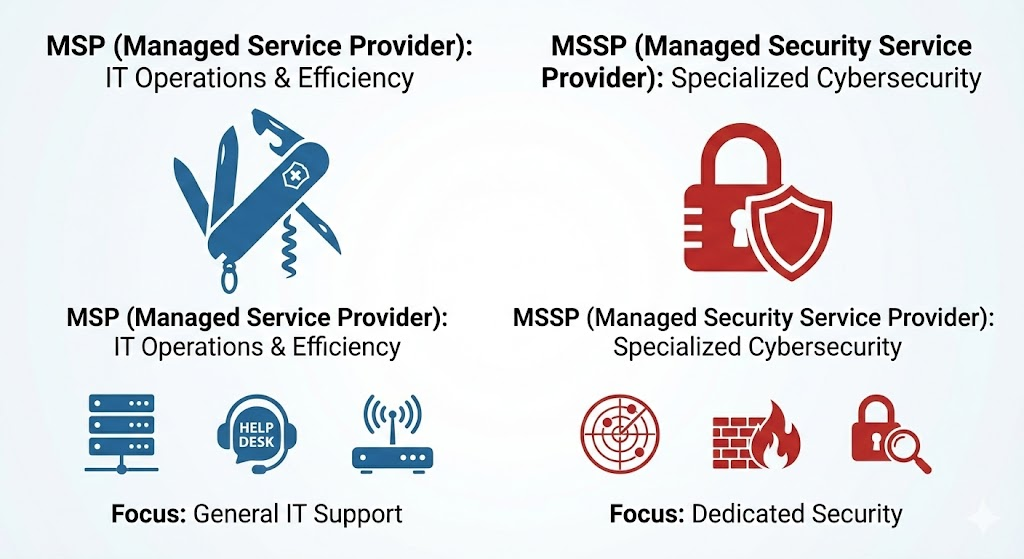
    You may already work with a Managed Service Provider (MSP) for IT support. While MSPs and MSSPs sound similar, they serve different purposes:

    Managed Service Providers (MSPs) focus on IT operations and business efficiency. They manage your infrastructure, handle help desk support, maintain systems, and ensure your technology runs smoothly for day-to-day business operations. Security may be part of their offering, but it’s not their primary focus.

    Managed Security Service Providers (MSSPs) exclusively focus on cybersecurity. They operate dedicated Security Operations Centers, provide 24/7 threat monitoring, and specialize in detecting and responding to security threats.

    Many businesses benefit from partnering with both—an MSP for IT operations and an MSSP for specialized security services. Increasingly, established MSPs are also expanding to offer MSSP services, recognizing the growing demand for dedicated security expertise.

    ThreatRepel partners with MSPs and IT providers to deliver specialized security services that complement their infrastructure management. If you’re an MSP looking to expand your security offerings, let’s talk.

    Is an MSSP Right for Your Small Business?

    Consider partnering with an MSSP if:

    • You lack dedicated security staff or expertise
    • Your IT team is overwhelmed managing both operations and security
    • You handle sensitive customer data (payment information, health records, personal information)
    • You face regulatory compliance requirements (HIPAA, PCI-DSS, GDPR, NY DFS, state privacy laws)
    • You want 24/7 security monitoring but can’t staff it yourself
    • You’re concerned about the financial and reputational impact of a data breach
    • You need security expertise but can’t afford to hire a full security team

    Not sure where you stand? ThreatRepel offers complimentary security consultations to help you understand your current risk posture and whether managed security services make sense for your business.

    ThreatRepel’s Approach to Managed Security

    At ThreatRepel, we don’t believe in one-size-fits-all security. Our approach is tailored to your business:

    Risk-Driven Strategy: We start by understanding your business, your data, and your unique risk profile. Security decisions should be based on actual business risk, not fear tactics.

    Transparent Communication: We explain security in business terms, not technical jargon. You’ll always understand what we’re doing and why it matters.

    Practical Solutions: We recommend security controls that fit your operational reality and budget. No unnecessary complexity, no shelf-ware.

    Measurable Outcomes: We track meaningful security metrics that demonstrate improvement in your security posture over time.

    Our Core Services

    Comprehensive Security Assessments: Deep-dive evaluations of your security posture with prioritized, actionable recommendations.

    Crisis Readiness Assessments: Prepare your organization to respond effectively when (not if) a security incident occurs.

    Application Security Program Development: Build security into your software development lifecycle from the ground up.

    Compliance Support: Navigate HIPAA, PCI-DSS, NY DFS, SOC 2, and other regulatory requirements with expert guidance.

    Managed Security Services: Ongoing monitoring, threat detection, and incident response tailored to your business needs.

    Making the Partnership Work

    To get the most value from an MSSP partnership:

    Be clear about your needs: Understand what data you need to protect, what regulations you must comply with, and where your biggest security concerns lie.

    Choose the right service level: MSSPs offer different tiers of service. A small business may not need the same level as a large enterprise—work with your MSSP to right-size the service to your actual risk and budget.

    Maintain communication: Your MSSP needs to understand your business, your systems, and your priorities. Regular communication ensures they can protect what matters most.

    View it as a partnership: The most effective MSSP relationships are true partnerships where both parties work together toward the common goal of protecting your business.

    Real-World Impact: What Our Clients Say

    “Working with ThreatRepel gave us the security expertise we desperately needed without the cost of hiring a full-time security team. They helped us achieve compliance and sleep better at night knowing professionals are watching our systems.”

    — Technology Company, Long Island

    “ThreatRepel’s crisis readiness assessment revealed gaps in our incident response plan we never would have found on our own. When we did face a security incident months later, we were prepared and contained it quickly because of their guidance.”

    — Healthcare Provider, New York

    Take the Next Step Toward Cyber Resilience

    For small and medium-sized businesses, cybersecurity is no longer optional—it’s a fundamental business requirement. Yet building comprehensive in-house security capabilities remains out of reach for most SMBs.

    Managed Security Service Providers bridge this gap, delivering enterprise-grade security expertise, technology, and protection at a cost small businesses can afford. By partnering with an MSSP, you gain peace of mind knowing security professionals are watching over your business 24/7, allowing you to focus on growth and innovation rather than constant worry about the next cyberattack.

    The question isn’t whether you can afford to work with an MSSP—it’s whether you can afford not to.

    Ready to strengthen your security posture?

    Schedule a complimentary security consultation with ThreatRepel:

    Let’s discuss your security challenges and explore how ThreatRepel can help protect your business, ensure compliance, and build cyber resilience—without breaking the bank.

    Your business deserves security that works as hard as you do. Let ThreatRepel be your trusted security partner.

  • Beyond Checklists: Real HIPAA Security for SMBs

    Healthcare organizations face mounting pressure to protect patient data while managing limited budgets and resources. Recent breach statistics reveal a troubling pattern: while healthcare providers submit the majority of breach reports to HHS, third-party vendors account for the overwhelming majority of compromised patient records. Understanding where vulnerabilities exist and how to address them has never been more critical.

    The Third-Party Vendor Problem

    Statistical analysis from breach reporting data shows that business associates represent a disproportionate risk. Although vendors submit only a fraction of total breach reports, they’re responsible for roughly two-thirds of all breached records. When non-regulated entities handling medical data are included, that figure climbs even higher.

    This disparity highlights a fundamental compliance gap. Healthcare organizations invest heavily in securing their own networks while inadvertently trusting critical patient data to vendors whose security postures may be inadequate or unknown.

    Strengthening Vendor Oversight

    Effective vendor management requires three core practices:

    Pre-Contract Due Diligence: Before signing agreements, organizations must thoroughly vet potential business associates. This includes reviewing documented security policies, procedures, and risk assessments. A robust business associate agreement forms the foundation, but contractual language alone provides insufficient protection.

    Ongoing Monitoring: HIPAA doesn’t mandate specific audit schedules, but a risk-based approach is essential. Organizations handling large volumes of electronic protected health information (ePHI), those with incident histories, or vendors presenting other risk indicators warrant annual reviews at minimum. More frequent assessments may be necessary based on risk profiles.

    Accountability Structures: When breaches occur at vendor sites, the Office for Civil Rights (OCR) holds covered entities responsible. Organizations cannot outsource accountability. Business associate agreements should require vendors to provide timely breach information and support, but the covered entity must own patient communications.

    Hidden Compliance Risks in Web Infrastructure

    Website security represents an often-overlooked vulnerability. Misconfigured web properties can create HIPAA violations when they result in unencrypted transmissions. Contact forms, patient portals, tracking software, and unsecured data transmission all present potential exposure points for ePHI.

    Both the Privacy and Security Rules apply to web infrastructure. Organizations need initial compliance reviews focusing on HIPAA-specific risks such as encryption requirements, secure transmission protocols, and privacy notices. Technical penetration testing and remediation typically require specialized IT security expertise.

    The State Law Compliance Gap

    Many healthcare organizations operate under the mistaken assumption that HIPAA represents their only compliance obligation. Federal requirements establish a baseline, but state laws frequently impose stricter standards with faster notification timelines and broader definitions of protected information.

    Comprehensive data privacy laws in various states now grant consumers extensive rights over their personal data, including the ability to request deletion, opt out of data sales, and pursue private legal action following security failures. These laws create compliance requirements that extend well beyond federal HIPAA standards.

    Privacy Rule Fundamentals

    Three critical Privacy Rule principles demand particular attention:

    Right of Access: Patients possess the right to access their medical records quickly and affordably. OCR has launched more than 50 enforcement actions specifically targeting right of access violations, signaling the priority placed on this standard. Individuals should not need to file complaints to obtain their own health information.

    Minimum Necessary Standard: Healthcare organizations must limit the patient information they use, access, or share to only what’s needed for specific tasks. This principle prevents unnecessary exposure of individually identifiable information while allowing providers to perform essential healthcare functions. Implementation requires more than policy documentation—it demands integration into daily operations.

    Operational Integration: Compliance policies cannot remain theoretical documents. The most common Privacy Rule failure involves treating HIPAA as a paperwork exercise rather than training staff to apply policies in real-world scenarios. This gap leads to accidental disclosures.

    Security Rule Priorities

    Three Security Rule elements require foundational attention:

    Enterprise-Wide Risk Analysis: Risk assessments must extend beyond electronic health record systems to encompass the entire organizational infrastructure. OCR’s enforcement work consistently reveals this as a key deficiency. The agency has launched a dedicated Risk Analysis Initiative following a 264% increase in reported large breaches involving ransomware since 2018.

    Encryption Standards: While not explicitly mandated, encryption should be considered essential. Organizations declining to encrypt ePHI must thoroughly document their rationale. This documentation becomes critical during investigations.

    Administrative Safeguards: Workforce training and other administrative controls carry equal importance to physical and technical safeguards. Compliance represents a synergistic process requiring robust policies and procedures across all domains. Technology purchases alone—whether firewalls, EHR systems, or third-party certifications—do not constitute compliance.

    The Certification Myth

    Organizations frequently encounter “HIPAA-compliant” badges, shields, and certificates offered by vendors. These represent marketing materials, not evidence of compliance. No government-recognized HIPAA certification exists, and OCR has repeatedly stated that private seals create no safe harbor.

    At best, these badges reflect point-in-time assessments by third parties. At worst, they generate false security for both organizations and patients. Covered entities remain responsible for conducting their own risk analyses, executing proper business associate agreements, and ensuring vendor controls match their specific environment. HIPAA compliance represents an ongoing process throughout an organization’s ecosystem, not a one-time achievement.

    Budget Realities for Compliance Programs

    HIPAA compliance costs vary significantly based on organization size, system complexity, and existing security infrastructure. While no official budget percentage exists, most small and mid-sized healthcare organizations allocate roughly 3-7% of operating budgets to Security Rule and HITECH requirements.

    Typical investment ranges include:

    • Enterprise-Wide Risk Analysis: $5,000-$20,000, depending on scope and whether technical testing is included
    • Security Rule Remediation: $10,000-$100,000+, with policies and procedures forming the backbone that OCR examines rigorously during investigations
    • Incident Response Planning: $3,000-$15,000 for customized tabletop exercises and planning
    • Annual Training: $20-$50 per employee or $1,000-$5,000 for tailored sessions

    Most SMBs face basic compliance startup costs in the low five figures. A single breach typically costs ten times that amount, making compliance investments comparable to insurance expenses.

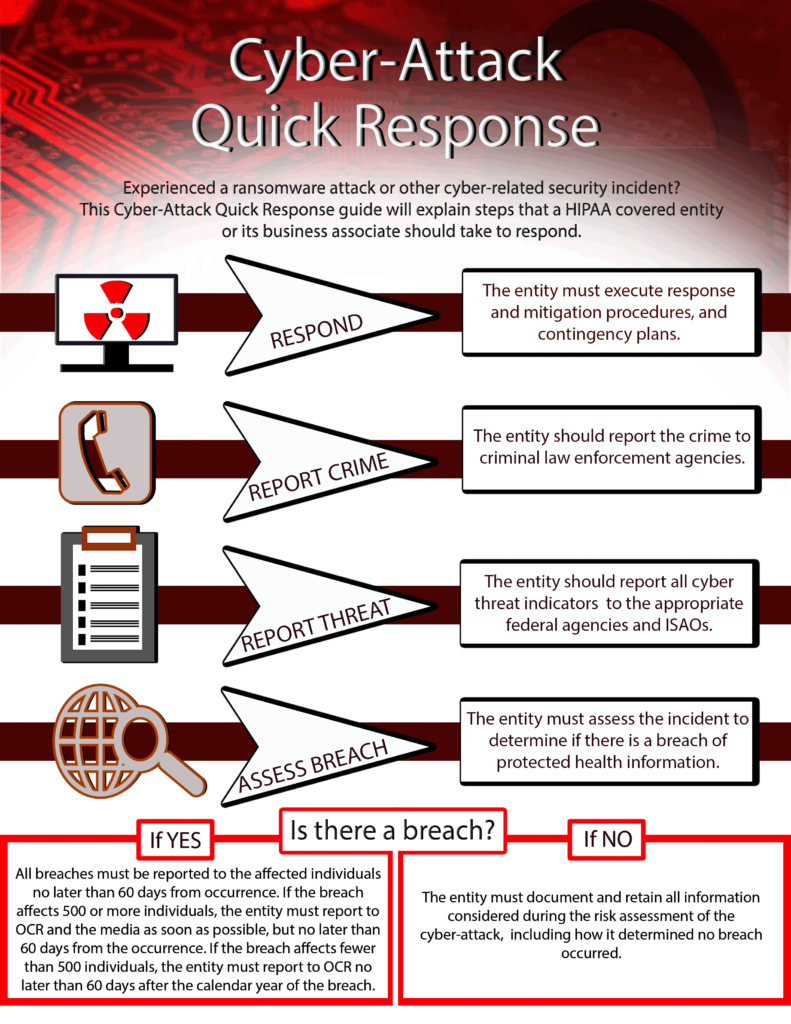
    Breach Notification: Communication Strategy Matters

    Effective breach notification requires three elements:

    Timeliness: Delays compound both regulatory and reputational harm. OCR opens investigations for every breach affecting 500 or more individuals, and increasingly investigates smaller breaches involving repeat offenders.

    Clarity and Completeness: Patients and regulators need plain-language explanations covering what happened, what it means for affected individuals, and what remediation steps are underway. Industry-standard breach notifications often rely on legalistic tone, reactive posture, minimal detail, and generic templates.

    Transparency: Patients deserve full disclosure of breach scope, including whether data has appeared on the dark web. Phrases like “we take privacy seriously” or “out of an abundance of caution” ring hollow. Organizations must acknowledge responsibility directly rather than deflecting blame.

    Legal counsel plays an important role, but compliance and communication requirements remain distinct from legal privilege. Organizations should align legal and communications strategies while ensuring regulatory requirements are met. Transparency and integrity must guide communications even when attorneys recommend limiting disclosures.

    Enforcement Landscape and Trends

    OCR enforcement extends beyond monetary penalties to include corrective action plans and ongoing monitoring requirements. The HITECH Act also granted State Attorneys General authority to bring civil actions on behalf of residents, creating additional enforcement channels.

    Recent developments include:

    Media-Based Investigations: OCR regularly opens investigations based on public breach reporting, not solely on formal reports submitted through official channels. This underscores the importance of prompt, accurate disclosure.

    Enforcement Initiatives: Following the Right of Access Initiative, OCR launched a Risk Analysis Initiative in fall 2024, with seven enforcement actions announced since. These targeted initiatives signal compliance priorities.

    Organizational Changes: The closure of six HHS regional offices has reduced local investigatory capacity while the Office of the General Counsel actively recruits for its Health Data Branch, suggesting increased centralization of HIPAA enforcement work.

    Regulatory Updates: The January 6, 2025 HIPAA Security Rule Notice of Proposed Rulemaking aims to strengthen cybersecurity requirements for ePHI. With final modifications potentially scheduled for May 2026, organizations may face just 240 days to achieve compliance following publication.

    Action Plan for 2026

    Healthcare organizations should prioritize these strategic investments:

    1. Conduct or update enterprise-wide risk analyses that examine all systems, not just EHRs
    2. Develop comprehensive policies and procedures integrated into daily operations
    3. Establish incident response capabilities including planning, routine monitoring, and tabletop exercises
    4. Implement workforce training programs that engage employees rather than treating training as a burden
    5. Strengthen vendor oversight through documented assessments and regular audits
    6. Review web properties for compliance with both Privacy and Security Rules
    7. Audit state law requirements to ensure compliance beyond federal minimums
    8. Prepare breach communication protocols emphasizing transparency and plain language

    The regulatory environment continues to evolve, with proposed Security Rule modifications and new enforcement priorities emerging. Organizations that treat compliance as an ongoing process rather than a checkbox exercise position themselves to protect both patient data and institutional reputation.


    For additional resources on HIPAA compliance, organizations can review materials available through the HHS Office for Civil Rights at hhs.gov/ocr and consult with qualified compliance professionals for organization-specific guidance.

  • Penetration Testing: Your Strategic Defense Against Cyber Threats

    What is Penetration Testing?

    Penetration testing (pentesting) is a simulated cyberattack against your systems conducted by security professionals. Think of it as hiring expert burglars to test your locks before real criminals do.

    Unlike automated scans that just flag potential issues, penetration testing actively exploits vulnerabilities to show their real-world impact. It reveals not just what could go wrong, but what damage an attacker could actually cause.

    The Key Difference:

    • Vulnerability Scan: “Your door lock could be picked.”
    • Penetration Test: “We picked your lock, accessed your vault, and here’s exactly how we did it.”


    Why It Matters to Your Business

    The Stakes:

    • $4.45M average cost of a data breach
    • 277 days average time to contain a breach
    • 60% of small businesses close within 6 months of a cyberattack

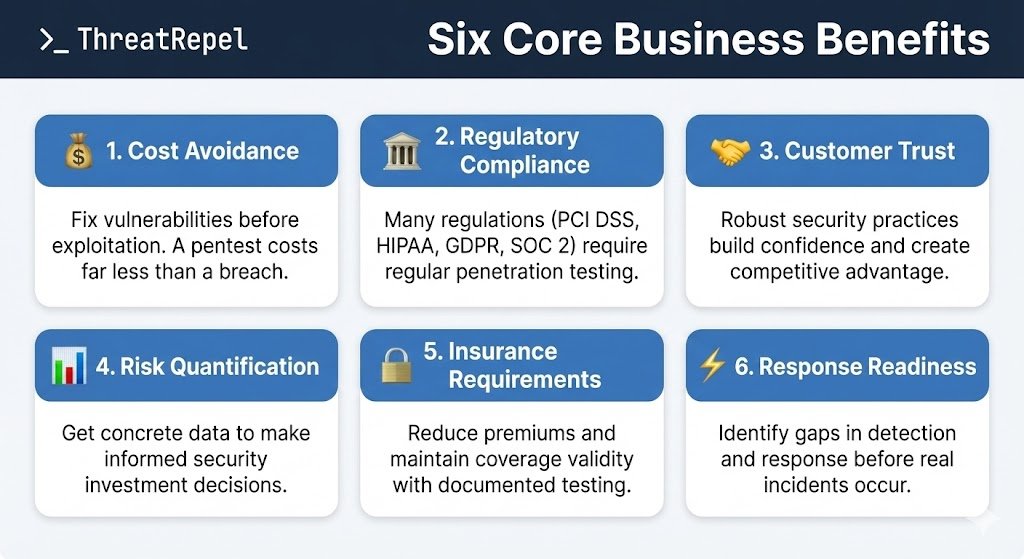
    Six Core Business Benefits

    1. Cost Avoidance 💰
    Fix vulnerabilities before exploitation. A pentest costs far less than a breach.

    2. Regulatory Compliance 🏛️
    Many regulations (PCI DSS, HIPAA, GDPR, SOC 2) require regular penetration testing.

    3. Customer Trust 🤝
    Robust security practices build confidence and create competitive advantage.

    4. Risk Quantification 📊
    Get concrete data to make informed security investment decisions.

    5. Insurance Requirements 🔒
    Reduce premiums and maintain coverage validity with documented testing.

    6. Response Readiness
    Identify gaps in detection and response before real incidents occur.


    Supporting Your Business Goals

    Penetration testing enables critical business initiatives:

    Digital Transformation 🚀
    Validate that cloud migration and new technologies don’t introduce unacceptable risk.

    Market Expansion 🌐
    Meet regional compliance standards and win enterprise customers with security evidence.

    M&A Success 💼
    Provide security due diligence that quantifies cyber risk in deals.

    Faster Launches ⏱️
    Catch vulnerabilities early in development to avoid costly post-launch fixes.

    Revenue Protection 📈
    Prevent breaches that cause downtime, data loss, and customer churn.


    The Bottom Line

    Penetration testing builds security-conscious organizations that confidently pursue business objectives while managing cyber risk.

    The real question: Can you afford NOT to test your defenses?

    In a landscape where attacks are inevitable, penetration testing provides assurance that your organization is prepared, resilient, and ready to defend what matters most.


    Ready to Strengthen Your Security?

    Contact us today to learn how penetration testing can protect your business and support your goals.